

It is late afternoon and a plumber is under a kitchen sink, fixing a leaking pipe. His phone rings. His hands are wet, the water is only half shut off, and the homeowner is standing next to him, so the call goes to voicemail. So does the next one. By the evening, he has three missed calls and no idea which ones were real jobs.

This happens in trades, salons and clinics every day. In fact, during busy seasons, it happens many times a day. Many callers who reach voicemail do not leave a message. Instead, they simply call the next business on the list.
That is why many owners are looking at an AI receptionist for small business. The idea is simple: something answers every call, day or night. However, an AI receptionist is not meant to replace your team. It is meant to work with them.
The difference between a useful AI receptionist and an annoying one is simple. A good one knows when to stop and hand the call to a real person. If you get that wrong, you have built an expensive voicemail. If you get it right, it saves you time and catches jobs you would have missed.
What an AI Receptionist Can Do for a Trade, Salon or Clinic
A good AI receptionist does a few simple things well:
- Answer the phone
- Answer basic questions, such as opening hours or service areas
- Take a message
- Send simple requests to the right person
That is enough. For the plumber above, the AI does not need to diagnose a leak or discuss prices. It only needs to get the caller’s name, address and what they need, ask if it is urgent, and pass a clear message to the owner.
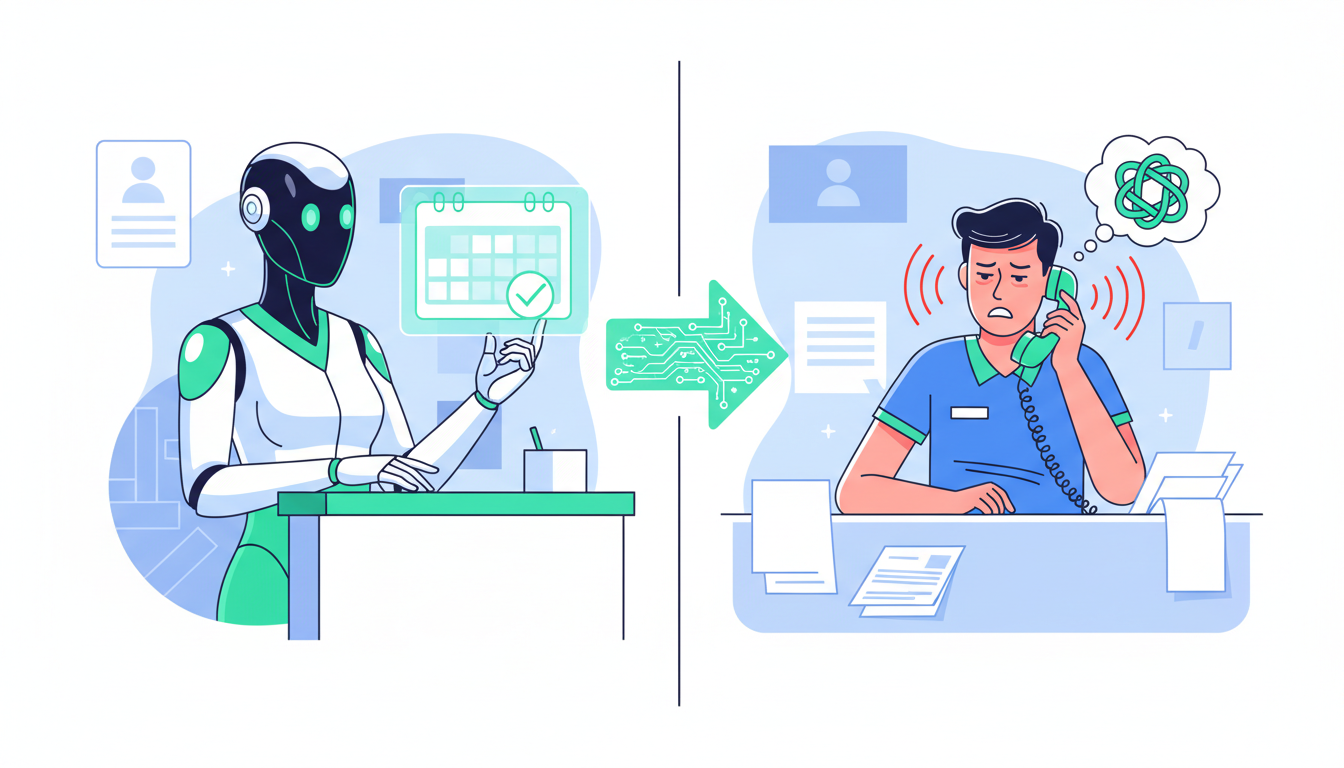
AI receptionists work best with narrow, repeatable tasks. They do not work well with open conversations where the caller could ask anything. They are also not good at judgement calls, exceptions to your rules, or understanding what an upset customer really needs.
Knowing these limits before you start is not negative thinking. It is practical. It helps you avoid the two biggest problems: callers going in circles, and jobs booked wrong because the system guessed instead of asking.
Give Your AI Receptionist One Clear Job
A common mistake is asking the AI to do everything on day one: answer questions, book appointments, route calls, qualify leads and handle complaints.
Do not do that. Pick one job:
- Take messages
- Answer basic questions
- Route calls to the right person
Think about it from the caller’s side. Someone calls because their basement is flooding. If the AI tries to answer pricing questions, check the calendar and qualify them as a lead all at once, it will probably fail at the one thing that matters: getting them help.
Every extra task is another place where things can go wrong. One job means fewer mistakes, and the mistakes that do happen are easy to find and fix.
To choose the job, look at what is costing you the most right now:
| Business type | Biggest problem | Best first job for the AI |
|---|---|---|
| Salon | The same booking requests all day | Collect booking requests for staff to confirm |
| Clinic | Many different types of calls | Route calls to the right person |
| Plumbing | Calls while on a job and after hours | Take messages and mark urgent ones (leaks, no water, no hot water) |
| Other trades (HVAC, electrical) | Too many calls in busy seasons | Take messages (name, address, job type) |
This may feel too simple. But it works. Once the one job runs well for a few weeks, it is easy to add more. Starting with everything and then trying to fix it is much harder.
Set Simple Handoff Rules
Choosing one job is step one. Step two, which many people skip, is deciding exactly when the AI should stop and bring in a person. Without this, the AI becomes a polite robot that will not let the caller go.
Three rules cover almost every case.
Rule 1: The AI cannot understand the caller. A bad connection, running water or a loud job site in the background, or a weak signal can make speech unclear. If the AI has to ask the caller to repeat themselves more than once or twice, it should stop guessing and pass the call on or take a simple callback number.
Rule 2: The request is outside the AI’s job. Emergencies, complaints, custom quotes and anything that needs judgement do not belong to the AI. A burst pipe at 2 a.m. is not a scheduling question. The caller needs a plumber on the phone now, not a booking form. An upset customer with a billing problem needs a person. The AI should notice that the request is outside its job, mark it as urgent if needed, and bring in a person quickly.
Rule 3: The caller asks for a person. This is the easiest rule. If someone asks to speak to a person, they get one. No extra questions first. Arguing with a caller is a fast way to lose the job.
Slow or confusing handoffs push customers away. The biggest complaints about AI phone systems are callers who have to repeat everything, or who never reach a person at all.
These rules are really just three “if this, then hand off” statements. Write them down before you turn anything on. They prevent most of the problems owners have with AI phone systems.
Take Extra Care With Bookings, Payments and Private Details
Taking a message is low risk. If a detail is wrong, you call back and fix it. Booking a real appointment or handling payment details is different.
Imagine the AI books the same plumber for two jobs on Thursday morning, on opposite sides of town. One customer is waiting at home for nobody, and you are making an apology call instead of doing the work. A booking mistake means wasted driving time and an unhappy customer. During a cold snap, when frozen and burst pipes bring in many calls at once, one mistake can upset the whole day.
Private information needs even more care. Names, addresses and phone numbers are personal information. In Canada, businesses that collect personal information in the course of business generally need to follow PIPEDA, the federal privacy law. In simple terms, that means:
- Tell customers why you collect each piece of information
- Get their consent
- Keep the information secure
This applies to small businesses too, not only large companies.
The safer approach:
- Let the AI collect and confirm basic details: name, address, job type and preferred time.
- Do not let the AI take card numbers or payment details over the phone.
- Have a person, or a system that checks your schedule, give the final booking confirmation.
Think of the AI as the person at the front desk who writes things down, not the person who makes final decisions.
Test Your AI Receptionist With Real, Difficult Calls
You have one job for the AI and three handoff rules. Everything looks good on paper. But paper does not call you from a flooded basement with water running in the background.
Real calls are messy. People mumble, interrupt, stop in the middle of a sentence, or ask three things at once. If your first real test is a live customer, you are not testing. You are taking a risk with a real job.
Test the hard calls on purpose
Think about the hardest calls you had this year, then ask a staff member or a friend to make calls like these:
- A caller with background noise or on speakerphone
- A name or street address that is easy to mishear
- An upset or stressed caller
- A caller who says nothing for a few seconds
- A request outside your service area
- A caller who asks for a person halfway through the call

The silent caller is a good test. Does the AI repeat itself, get confused or hang up? Many systems that sound good in a demo fail at this simple test.
Look for patterns
One bad call does not mean much. The same mistake again and again does.
Maybe the AI handles noise well but gets street numbers wrong, such as “47B” becoming “47”. Maybe it does well with calm callers but does not hand off upset callers fast enough. Write these down. Most problems are not about the technology. They come from unclear handoff rules or no plan for what happens after a transfer.
When you find a pattern, fix the rule that should have caught it. This is not a one-time setup. Small changes over time make the system work well.
Run it next to your old system first
Once the AI is live, you will want to stop answering calls yourself. Do not stop yet.
Keep your old process running for about two weeks. For a one- or two-person plumbing business, that could mean the AI answers first, but you check every message against your missed calls and voicemails. It is a little extra work, but much better than finding out later that it lost half your emergency calls.
When it runs smoothly, hands off correctly and handles the messy calls, then you can rely on it.
Start Small and Keep People in Charge
Here is a quick summary:
- One job, not five. Message-taking with urgent flags for a plumber, booking requests for a salon, routing for a clinic. Get one working well before adding more.
- Three handoff rules. The AI cannot understand the caller, the request is outside its job, or the caller asks for a person.
- Extra care with bookings, payments and private details. The AI collects information. A person or a checked system confirms.
- Real testing. Noise, silence, upset callers and odd requests, before real customers call.
Start smaller than feels comfortable. Watch it for a few weeks, then grow it slowly. It is not exciting, but it works.
An AI receptionist does not replace your judgement. It is a filter. It catches calls you cannot answer, marks what is urgent and passes you what needs a person. You still decide prices on tricky jobs. The salon owner still handles the refund request. That should not change.
If you run a plumbing, trades or other service business and want a simple way to capture missed calls and lead details, I build small automations for exactly that. You can get in touch here. No pressure, I’m happy to answer questions.